



Contributor
REGULAR CONTENT
“In the later part of 20th Century, Japan was a major innovator in the pharmaceutical industry,” says Kurt R. Sedo, vice president of operations, PharmaCircle, a drug delivery and formulation intelligence company. “Decreased funding in R&D, due to factors such as strict price controls and slow regulatory processes, has allowed other countries in Asia such as China and South Korea to leapfrog Japan in biopharma in the last 20 years.”
Artificial Intelligence (AI) could be the answer to Japan taking back its leading innovator role. The Japan AI in healthcare market reached $1.42 billion in 2024 and is expected to soar to $14.8 billion by 2033, driven by an aging population, government support for digital health, rising hospital adoption of AI diagnostics, clinician shortages, advances in imaging and precision medicine, expanding health data infrastructure, and collaborations between technology firms and providers.1
According to DataM intelligence 4 Market Research, Japan's AI in the healthcare market is transforming the healthcare sector by leveraging AI to enhance diagnostics, treatment planning, drug development, and patient management systems. AI analyzes medical images such as X-rays, CT scans, and MRI scans to improve diagnostic accuracy and speed. Companies like LPixel and Fujifilm Corporation are leading in this area, with AI algorithms capable of detecting abnormalities that may not be visible to the human eye. This past September, leading Japanese healthcare providers rolled out AI‐driven clinical decision support systems (CDSS) for chronic disease management and precision‐medicine care pathways, integrating them into electronic medical records.
A University of Tokyo research team developed AI models that can help deliver personalized infertility treatments by predicting the number and quality of eggs that a woman has. The AI models can accurately predict a patient’s ovarian function by using answers to simple questions — such as age and menstrual cycle — and a small sampling of blood. Until now, accurately assessing the health of an ovary was difficult due to individual differences. But with the AI models, ovarian function can be measured more easily and appropriate infertility treatments can be recommended to suit each person, the study said.2
Sedo says one significant bright spot in biotech is Japan’s leadership in the development and commercialization of antibody drug conjugates (ADCs). Integrating AI with ADCs is driving innovation in precision medicine. “Top Japanese pharma led the way with three of top-five selling ADCs being developed with significant input from Japan-based pharma,” he says.
Japan is also aggressively pursuing the use of AI in precision oncology treatment. By therapeutic area, oncology commanded 18.73% of Japan’s pharmaceutical market share in 2025.3 The Japan AI-powered precision oncology platform market was valued at $65 million in 2024, and by therapeutic area, oncology commanded 18.73% of Japan’s pharmaceutical market share in 2025, expected to jump significantly by 2031.3
Figure 1: Innovator Products Approved by Japanese Companies 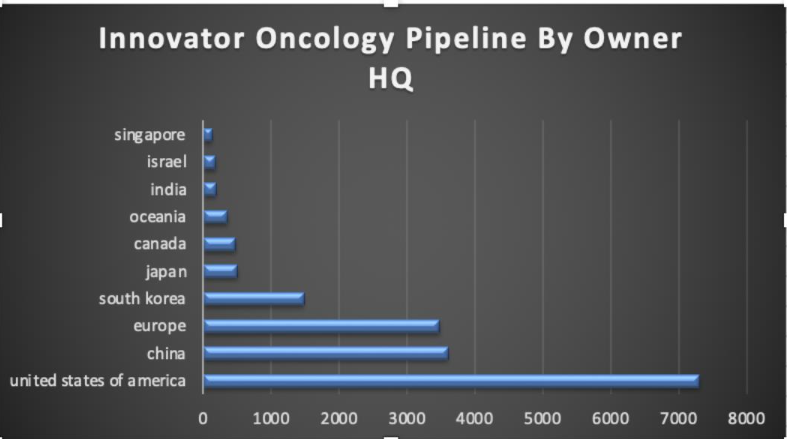
Source: PharmaCircle LLC
Tokyo, Osaka, and Yokohama are the dominant cities in the AI precision oncology sector with leading universities and research centers facilitating the development and adoption of such technology, which includes: diagnostic platforms, therapeutic decision platforms, patient monitoring, data management, research platforms, and clinical trial platforms.4
Japan is also at the forefront of AI in research and development. In June, The Japanese parliament’s upper house has passed a bill to promote research and development (R&D) in AI. The law aims to keep Japan at the forefront of the technology, considers the wider impact of AI on society and the economy, and gives the government new powers to investigate firms in the AI industry.5 Following the passage, key pharmaceutical deals abounded. For example, Takeda doubled down on its strategic commitment with AI drug designer Nablo Bio. The new project will use Nabla’s Joint Atomic Model (JAM) across Takeda’s early-stage programs, according to the release, to generate new antibodies, multi-specifics and other therapeutics for multiple targets at once.6
“Since 2022, we’ve collaborated with Takeda to push the boundaries of next-generation biologics discovery,” said Surge Biswas, PhD, Nabla’s CEO and co-founder, in the printed statement. “This second collaboration builds on the success of our first program and reflects our shared conviction that de novo design and AI-driven optimization can unlock entirely new therapeutic spaces.”
Reducing R&D costs, and ultimately drug costs, with AI is the ultimate goal. This begins with target identification. One of the first enterprises to address this stage is Japanese company Fronteo. Utilizing its proprietary natural language processing AI engine KIBIT, the company analyzes vast medical and pharmaceutical literature to generate innovative drug ideas that researchers may not have considered. KIBIT identifies new molecular targets that might be effective against specific diseases. To do so, it analyzes vast amounts of academic literature. It can even derive specific hypotheses. Furthermore, KIBIT can identify and suggest highly disease-relevant target molecules that are not explicitly mentioned in the literature. This significantly enhances drug discovery potential. Hopes are high for FRONTEO's KIBIT. If it can consistently generate innovative new drugs efficiently, it may help deliver affordable medicines.7
The personalized medicine market in Japan is expected to exceed around $10 billion in the future, driven by patient preferences for tailored therapies. This shift towards individualized treatment plans is supported by advancements in genomics and biomarker research, which are integral to precision oncology. As patients increasingly seek therapies that align with their unique genetic profiles, AI-powered platforms are positioned to meet this demand effectively, enhancing treatment outcomes.4
“There appears to be renewed interest in the biotech industry in Japan,” says Sedo. “With its already strongly established legacy of innovation and quality, Japan is once again poised to once again become a leader in pharmaceutical technology innovation.”
“In the later part of 20th Century, Japan was a major innovator in the pharmaceutical industry,” says Kurt R. Sedo, vice president of operations, PharmaCircle, a drug delivery and formulation intelligence company. “Decreased funding in R&D, due to factors such as strict price controls and slow regulatory processes, has allowed other countries in Asia such as China and South Korea to leapfrog Japan in biopharma in the last 20 years.”
Artificial Intelligence (AI) could be the answer to Japan taking back its leading innovator role. The Japan AI in healthcare market reached $1.42 billion in 2024 and is expected to soar to $14.8 billion by 2033, driven by an aging population, government support for digital health, rising hospital adoption of AI diagnostics, clinician shortages, advances in imaging and precision medicine, expanding health data infrastructure, and collaborations between technology firms and providers.1
According to DataM intelligence 4 Market Research, Japan's AI in the healthcare market is transforming the healthcare sector by leveraging AI to enhance diagnostics, treatment planning, drug development, and patient management systems. AI analyzes medical images such as X-rays, CT scans, and MRI scans to improve diagnostic accuracy and speed. Companies like LPixel and Fujifilm Corporation are leading in this area, with AI algorithms capable of detecting abnormalities that may not be visible to the human eye. This past September, leading Japanese healthcare providers rolled out AI‐driven clinical decision support systems (CDSS) for chronic disease management and precision‐medicine care pathways, integrating them into electronic medical records.
A University of Tokyo research team developed AI models that can help deliver personalized infertility treatments by predicting the number and quality of eggs that a woman has. The AI models can accurately predict a patient’s ovarian function by using answers to simple questions — such as age and menstrual cycle — and a small sampling of blood. Until now, accurately assessing the health of an ovary was difficult due to individual differences. But with the AI models, ovarian function can be measured more easily and appropriate infertility treatments can be recommended to suit each person, the study said.2
Sedo says one significant bright spot in biotech is Japan’s leadership in the development and commercialization of antibody drug conjugates (ADCs). Integrating AI with ADCs is driving innovation in precision medicine. “Top Japanese pharma led the way with three of top-five selling ADCs being developed with significant input from Japan-based pharma,” he says.
Japan is also aggressively pursuing the use of AI in precision oncology treatment. By therapeutic area, oncology commanded 18.73% of Japan’s pharmaceutical market share in 2025.3 The Japan AI-powered precision oncology platform market was valued at $65 million in 2024, and by therapeutic area, oncology commanded 18.73% of Japan’s pharmaceutical market share in 2025, expected to jump significantly by 2031.3
Figure 1: Innovator Products Approved by Japanese Companies
Source: PharmaCircle LLC
Tokyo, Osaka, and Yokohama are the dominant cities in the AI precision oncology sector with leading universities and research centers facilitating the development and adoption of such technology, which includes: diagnostic platforms, therapeutic decision platforms, patient monitoring, data management, research platforms, and clinical trial platforms.4
Japan is also at the forefront of AI in research and development. In June, The Japanese parliament’s upper house has passed a bill to promote research and development (R&D) in AI. The law aims to keep Japan at the forefront of the technology, considers the wider impact of AI on society and the economy, and gives the government new powers to investigate firms in the AI industry.5 Following the passage, key pharmaceutical deals abounded. For example, Takeda doubled down on its strategic commitment with AI drug designer Nablo Bio. The new project will use Nabla’s Joint Atomic Model (JAM) across Takeda’s early-stage programs, according to the release, to generate new antibodies, multi-specifics and other therapeutics for multiple targets at once.6
“Since 2022, we’ve collaborated with Takeda to push the boundaries of next-generation biologics discovery,” said Surge Biswas, PhD, Nabla’s CEO and co-founder, in the printed statement. “This second collaboration builds on the success of our first program and reflects our shared conviction that de novo design and AI-driven optimization can unlock entirely new therapeutic spaces.”
Reducing R&D costs, and ultimately drug costs, with AI is the ultimate goal. This begins with target identification. One of the first enterprises to address this stage is Japanese company Fronteo. Utilizing its proprietary natural language processing AI engine KIBIT, the company analyzes vast medical and pharmaceutical literature to generate innovative drug ideas that researchers may not have considered. KIBIT identifies new molecular targets that might be effective against specific diseases. To do so, it analyzes vast amounts of academic literature. It can even derive specific hypotheses. Furthermore, KIBIT can identify and suggest highly disease-relevant target molecules that are not explicitly mentioned in the literature. This significantly enhances drug discovery potential. Hopes are high for FRONTEO's KIBIT. If it can consistently generate innovative new drugs efficiently, it may help deliver affordable medicines.7
The personalized medicine market in Japan is expected to exceed around $10 billion in the future, driven by patient preferences for tailored therapies. This shift towards individualized treatment plans is supported by advancements in genomics and biomarker research, which are integral to precision oncology. As patients increasingly seek therapies that align with their unique genetic profiles, AI-powered platforms are positioned to meet this demand effectively, enhancing treatment outcomes.4
“There appears to be renewed interest in the biotech industry in Japan,” says Sedo. “With its already strongly established legacy of innovation and quality, Japan is once again poised to once again become a leader in pharmaceutical technology innovation.”